Why Does Food Get Stuck Around My Implant?
21 September 2026
One of the more common things patients mention after implant treatment is: “Food keeps getting trapped around my implant.” Sometimes it is only mildly annoying. Other times, patients begin noticing soreness, bleeding when cleaning, or an unpleasant taste around the area and understandably start wondering whether something may be wrong with the implant itself. It is a conversation we have surprisingly often.
The reassuring news is that food trapping does not automatically mean an implant is failing. However, it is also not something I generally advise ignoring. Like many things in dentistry, the answer is usually more nuanced than patients expect.
One of the things patients are often surprised to learn is that implants and natural teeth are biologically different. Natural teeth are suspended within the bone by a periodontal ligament and have a unique relationship with the surrounding tissues. Dental implants integrate directly with the bone and the soft tissues around them heal differently.
This means that the shape of the crown, the contour of the gums, the position of neighbouring teeth and the way the area is cleaned all become particularly important. In many cases, food trapping is not caused by a problem with the implant itself. It is often related to the anatomy and how the surrounding tissues have healed and matured over time.
There are several possible explanations. Sometimes the gums naturally remodel slightly following treatment, creating small spaces where food may collect more easily. Occasionally neighbouring teeth shift subtly over the years. In other situations, the contour of the restoration itself may make certain areas more difficult to clean effectively.
One of the things I have learned over the years is that patients are often remarkably tolerant of small annoyances around implants. They adapt. They chew differently. They clean more frequently. They avoid certain foods. Sometimes they live with the problem for years before mentioning it. Yet these small details can often tell us something important about how an implant is functioning in everyday life.
Not necessarily. Very small amounts of trapping may simply reflect the anatomy of the area and may be manageable with appropriate cleaning techniques. However, persistent trapping associated with bleeding, inflammation, discomfort or difficulty cleaning deserves assessment. One of the challenges with implant dentistry is that inflammation around implants can initially remain surprisingly quiet.
Patients often tell me: “The implant doesn’t hurt. It just traps food.” Yet ongoing plaque accumulation and chronic irritation can sometimes contribute to peri-implant inflammation if left unmanaged over time. This is one reason why maintenance remains such an important part of successful implant treatment.
One of the things I discuss regularly with patients is that successful implant dentistry is not simply about placing an implant successfully on the day of surgery. Long-term success depends on many factors. Cleansability. Bite stability. Gum health. Regular professional maintenance. And the patient’s ability to comfortably care for the area every day. An implant may look excellent on the day it is fitted, but the real measure of success is how it performs years later.

Fortunately, many cases of food trapping can be improved. Sometimes relatively simple adjustments help. Sometimes reviewing cleaning techniques and interdental aids makes a significant difference. In other situations, it may be worth assessing whether the contour of the restoration itself could be improved. Grinding and bite forces can also occasionally influence how restorations function over time, particularly in patients who place significant pressure on implants. The important thing is understanding the cause before deciding on the solution.
Patients are often relieved to discover that food trapping does not automatically mean something is wrong with the implant. However, it is rarely something I recommend simply accepting without assessment. Small changes around implants often become important precisely because our goal is not simply to make implants survive. It is to make them comfortable, maintainable and easy to live with for many years to come.
At Implant & Perio Clinic in Marylebone, near Harley Street, long-term implant maintenance forms an important part of treatment planning from the very beginning. Patients are supported closely by our experienced hygienists, and where necessary more advanced peri-implant concerns are assessed collaboratively within the team. Because successful implant dentistry is not only about replacing missing teeth. It is about ensuring they remain biologically healthy and function comfortably long into the future.
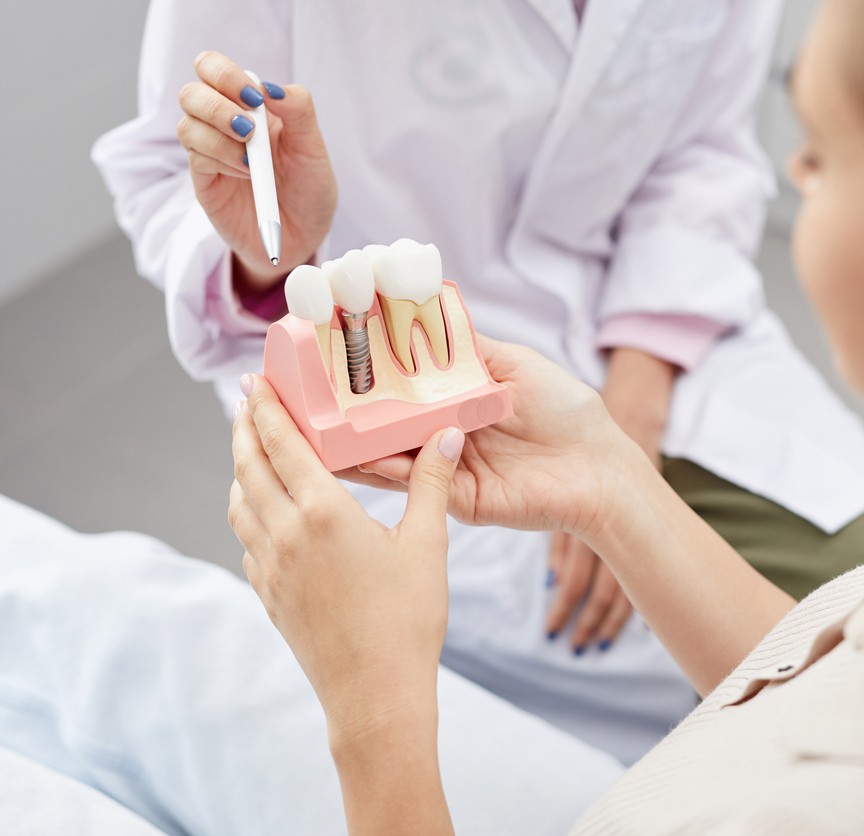
Dr Pedram Negahban DDS (Germany), DipImpDent RCS (Eng.), AssocFCGDent, is Clinical Director of Implant & Perio Clinic in Marylebone, Central London.
He has a particular interest in long-term implant maintenance and believes that successful implant dentistry should remain comfortable, cleansable and biologically healthy long after treatment has been completed.
Implant & Perio Clinic is located on Portland Place, Marylebone, near Harley Street, London W1