Why visit us for
immediate implants?
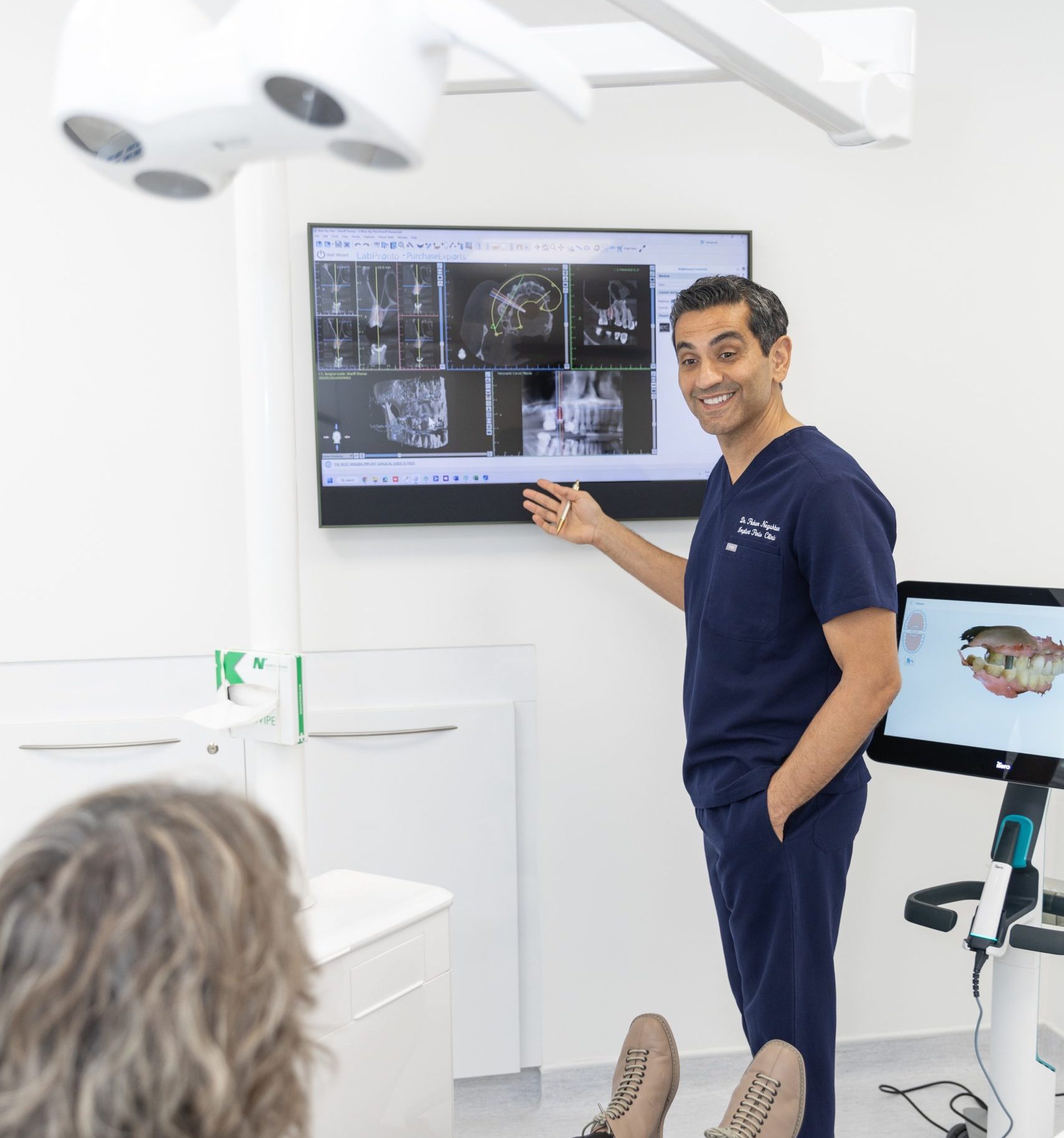
- Unmatched clinical expertise and proficiency
- Advanced state-of-the-art technology and equipment
- Consistent success with complex clinical cases
- Modern, cutting-edge materials and methodologies
Why visit us for immediate implants?
Fast
A temporary crown is attached right away, meaning you can walk out of our practice with a complete, natural-looking smile.
Safe
Dr Pedram Negahban has vast experience, and you are in safe hands.
Streamlined
By combining the extraction, implant placement, and temporary restoration, the process is seamless.
Preservation
Placing an implant immediately after extraction helps support the surrounding gum tissue and preserves your jawbone.
Spread the cost of your immediate implants
Are you interested in flexible payment options for your immediate implants? We can help! At Implant & Perio, we offer the chance to spread the cost of your treatment into monthly payments that suit your budget and your lifestyle, subject to status.
Get in touch to find out more.
Why choose us for immediate dental implants
Immediate implant placement can offer patients the possibility of replacing a failing tooth without waiting for the extraction site to heal before implant treatment begins. However, achieving a successful result depends on careful case selection, precise planning and experienced clinical judgement.
At Implant & Perio, your treatment is planned and carried out by Dr Pedram Negahban, DDS (Germany), Diploma in Implant Dentistry RCS Eng, who has many years of experience in immediate implant placement as part of his advanced implant practice.
Frequently Asked Questions
An immediate dental implant is an implant that is placed at the same appointment as the removal of a tooth. Instead of removing the tooth and waiting for the area to heal before placing the implant, the implant is carefully positioned in the extraction site straight away, where the clinical conditions allow.
This can reduce the number of surgical procedures and, in suitable cases, may help preserve the bone and gum tissues around the extraction site.
However, immediate placement is not suitable for every tooth or every patient. Dr Negahban will assess the available bone, surrounding tissues and the individual site carefully before recommending whether immediate or delayed implant placement is the better approach.
Yes, in suitable cases an implant can be placed at the same appointment as the tooth is removed.
After the tooth is carefully extracted, Dr Negahban will assess the site and, where the conditions are favourable, place the implant directly into the extraction site. The decision depends on factors including the amount and quality of the remaining bone, the condition of the surrounding gum tissues and whether the implant can achieve good initial stability.
If these conditions are not suitable, Dr Negahban may recommend allowing the area to heal first, or carrying out additional procedures such as bone grafting before or alongside implant treatment. The aim is always to choose the approach that provides the best foundation for the implant rather than simply the fastest treatment.
In many suitable cases, yes. However, placing an implant immediately and providing a temporary tooth on the same day are two separate clinical decisions.
Once the implant has been placed, Dr Negahban will assess its stability, the surrounding bone and gum tissues, and how the temporary tooth will function within your bite. If the conditions are favourable, a temporary tooth may be fitted on the same day.
The temporary tooth is carefully designed to protect the implant during the early healing period while maintaining appearance and supporting the surrounding tissues. It is not the final restoration. Once the implant has healed and integrated with the bone, the definitive tooth can be made.
If attaching a temporary tooth directly to the implant could compromise healing, Dr Negahban will recommend a different temporary solution while the implant is allowed to heal undisturbed.
The best candidates for immediate implant placement are patients where there is sufficient healthy bone to position and stabilise the implant correctly, and where the surrounding gum tissues can be predictably managed.
However, suitability is not determined by one factor alone. Dr Negahban will assess the condition of the extraction site, the available bone and gum tissues, the position of the tooth, your bite, oral health, general health and smoking history.
Importantly, some bone loss or infection does not automatically rule out an immediate implant. In selected cases, the site can be carefully cleaned and managed, and bone grafting may be carried out at the same time. In other cases, a staged approach is safer and provides a better foundation for the implant.
This is why the decision is made after a clinical examination and appropriate imaging rather than simply from the appearance or condition of the tooth.
Possibly. Infection or bone loss does not automatically mean that an immediate implant cannot be placed, but the extent and location of the problem need to be carefully assessed.
If infection is present, Dr Negahban will assess whether the affected tissue can be thoroughly removed and whether there is sufficient healthy bone remaining to position and stabilise the implant correctly. Similarly, some bone defects can be managed with bone grafting at the same time as implant placement.
However, there are situations where the infection, bone loss or condition of the surrounding tissues makes immediate placement less appropriate. In these cases, the site may need to be treated and allowed to heal, with the implant placed at a later stage.
The decision is therefore not simply whether infection or bone loss is present, but whether the site provides the right conditions for a stable, correctly positioned implant and predictable healing.
In appropriately selected cases, immediate dental implants can achieve very good long-term outcomes. However, immediate placement is not automatically better than placing an implant after the extraction site has healed.
The outcome depends on several factors, including careful case selection, correct implant positioning, good initial stability, the condition of the surrounding bone and gum tissues, and appropriate healing and maintenance.
For some patients, immediate placement offers clear advantages and avoids an additional surgical procedure. For others, allowing the site to heal first provides better conditions for implant placement.
The aim is therefore not to choose the quickest technique, but the technique that is most appropriate for the individual site and gives the implant the best foundation for long-term success.
Although the implant is placed at the same appointment as the tooth is removed, it still needs time to heal and integrate with the surrounding bone.
Where the implant has sufficient stability and the clinical conditions are suitable, Dr Negahban will often provide a temporary tooth on the same day as the implant is placed. This maintains the appearance of the tooth during healing, while the temporary restoration is carefully designed to protect the implant from excessive pressure.
In most straightforward cases, the final crown is fitted at around three months. The exact timing can vary depending on the implant site, bone quality, whether bone grafting has been required and how the individual patient heals.
Before fitting the final crown, Dr Negahban will assess the implant and surrounding tissues to ensure they are ready for the definitive restoration.
After immediate implant treatment, it is important to avoid putting unnecessary pressure on the implant while it is healing, particularly when a temporary tooth has been fitted on the same day.
Dr Negahban will usually recommend a soft diet during the early healing period, avoiding hard, crunchy or very chewy foods around the treated area. If you have an immediate temporary tooth, it is important not to use it to bite directly into hard foods, even if it feels comfortable.
As healing progresses, you can gradually return to a more normal diet according to the advice given at your review appointments. The exact recommendations may vary depending on the implant site, whether bone grafting was carried out and the type of temporary restoration provided.