Why visit us for
multiple implants?
- Outstanding skill and proven professional excellence
- Equipped with the latest advanced diagnostic and treatment tools
- Consistently delivering reliable outcomes for challenging treatments
- Utilising modern, high-quality methodologies for lasting results
What are the benefits of having multiple dental implants with us?
Leading
We offer leading clinical excellence and expertise in delivering precision patient care.
Advanced
Dr Pedram Negahban has vast experience and utilises modern equipment designed for accuracy and comfort.
Proven
We have a high success rate amongst even the most complex cases.
Innovative
We use the latest evidence-based materials and methods.
You may not need an implant for every missing tooth
A common misconception among patients considering multiple dental implants is that every single missing tooth requires its own individual implant. In reality, this is rarely necessary.
When several adjacent teeth are missing, we can strategically place two or more implants to support an implant-supported bridge. For example, three missing teeth can often be replaced using 2 dental implants supporting a 3-unit bridge. Four to five missing teeth can frequently be supported by 2 or 3 dental implants.
This approach provides a stable, long-lasting restoration while reducing surgical intervention, treatment complexity, and total cost.
Assessment & planning process
Comprehensive assessment is the foundation of every successful dental implant procedure at our Marylebone practice. It’s important to assess bone volume and quality, gum health and the bite. In your assessment, you can expect the following: –
Detailed clinical examination: Dr Negahban performs a complete evaluation of your remaining natural teeth, bite alignment, and soft tissue health.
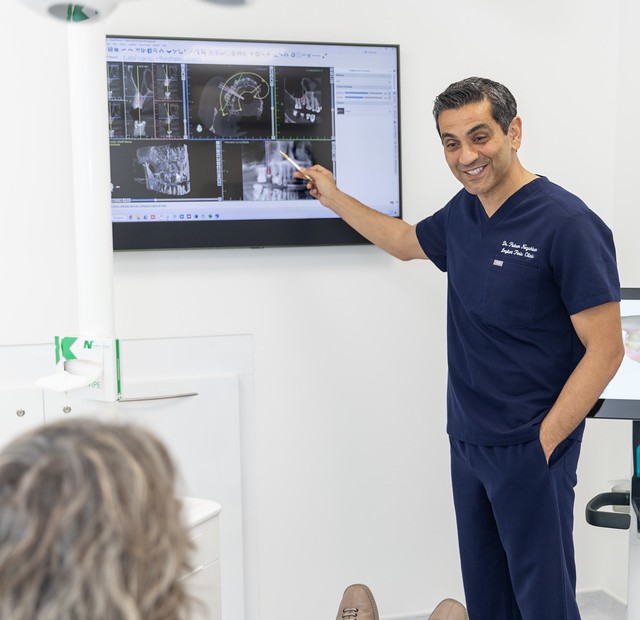
High-precision 3D CBCT scanning: Where appropriate, we take low-radiation 3D cone-beam CT (CBCT) scans. This allows Dr Negahban to view your jawbone volume, density, and anatomical structures (such as nerves and sinus cavities) in high-definition 3D.
Digital intraoral scans: We can use fast, comfortable digital impressions, which eliminate the need for messy traditional trays and allow us to virtually plan your bridge.
Periodontal & gum health check: Implants require healthy gum tissue to thrive long term. We carefully evaluate and optimise your gum foundation prior to implant placement.
Consider bone grafting and sinus lift/sinus augmentation: We assess the jaw, as the position of the sinus can affect the amount of bone available for implant placement.

Bone grafting & sinus lifts
If teeth have been missing for a long time, the jawbone naturally shrinks (resorbs). In some cases, there may not be enough bone height or width to support an implant safely.
When necessary, Dr Pedram Negahban performs gentle bone augmentation procedures to rebuild the bone foundation:
- Bone grafting: Adding specialised bone grafting material to areas of low volume to create a dense, stable environment for implant integration.
- Sinus augmentation / Sinus lift: In the upper back jaw (near the molars and premolars), the maxillary sinus cavity often sits close to the jawbone. When bone depth is reduced, a sinus lift gently elevates the sinus membrane and places grafting material underneath, creating sufficient bone height for secure implant placement.
Aftercare
At Implant & Perio Clinic, long-term maintenance is an essential part of your treatment plan, never an afterthought.
Just like natural teeth, implants rely on healthy supporting bone and gums to remain stable. Unchecked plaque buildup can lead to peri-implantitis (inflammation and bone loss around the implant).
Our comprehensive maintenance protocol includes tailored home-care guidance with personalised tools for cleaning under and around your implant bridge. You will also attend regular clinical reviews with Dr Pedram Negahban to monitor your bite and structural integrity, alongside dedicated visits with our dental hygienists and therapists to protect your long-term periodontal health.
Spread the cost of your multiple dental implants
Are you interested in flexible payment options for your multiple dental implants? We can help! At Implant & Perio, we offer the chance to spread the cost of your treatment into monthly payments that suit your budget and your lifestyle, subject to status. Please get in touch to find out more.
Our clinical philosophy
Dr Negahban believes that successful implant dentistry starts with the final outcome in mind. Rather than placing implants purely where bone exists, he utilises a “top-down” reverse treatment planning methodology.
He begins by designing your final smile, mapping out the ideal shape, position, bite, and appearance of your replacement teeth. From there, he works backwards to determine the exact number, angles, and precise positions of the implants required to support those teeth predictably. Throughout this process, he carefully analyses all biomechanical forces, accounting for your unique bite, chewing pressure, available bone density, and long-term structural balance.
Frequently Asked Questions
An implant-supported bridge and a conventional bridge both replace multiple missing teeth in a row, but they rely on entirely different support systems. A conventional bridge relies on the healthy natural teeth on either side of the gap, which must be trimmed down to serve as anchors for the replacement teeth.
In contrast, an implant-supported bridge is anchored securely into the jawbone using titanium implants. This means your surrounding healthy teeth remain 100% untouched and preserved. Additionally, because dental implants act as artificial tooth roots, they stimulate the jawbone to prevent the bone loss that naturally occurs under a conventional bridge, offering a more stable, long-lasting, and natural-feeling solution. In suitable cases, implants can allow several missing teeth to be replaced without preparing healthy neighbouring teeth to support the bridge.
The procedure is carried out under local anaesthetic, ensuring you feel completely comfortable throughout. Any mild post-procedure discomfort can easily be managed with standard over-the-counter pain relief.
With precise placement by an experienced dentist like Dr Pedram Negahban and commitment to regular hygiene check-ups, dental implants have a long-term success rate exceeding 95% and can last a lifetime.
In most cases, a bridge replacing 3 or 4 missing teeth in a row can be securely supported by just 2 dental implants, avoiding the need for individual implants for every gap.